

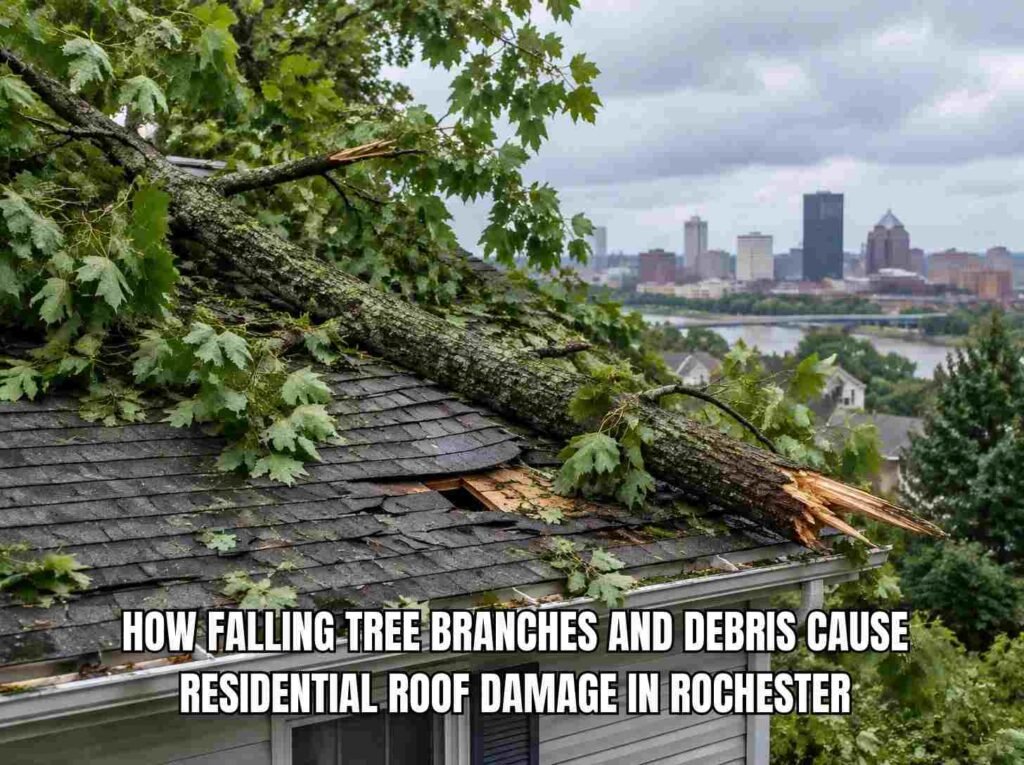
How Falling Tree Branches and Debris Cause Residential Roof Damage in Rochester is an important topic for homeowners who want to understand the risks that nearby trees can create for their roofing systems. A falling branch can cause only minor surface damage but may cause several other damages on the roofing such as shingles, underlayment, roof decking, flashing and gutters etc. Sometimes the damage will not be seen from the ground and moisture can be trapped in the roof structure with subsequent rain.
Rochester’s changing weather conditions can increase the possibility of branches breaking or becoming unstable. Strong winds, ice accumulation, and heavy snow can put extra strain on tree limbs, leading to conditions where debris can land on properties nearby. The size, weight, and landing location of the branches and the condition of the roof surface can cause various types of Rochester residential roof damage.
By understanding how these impacts occur, homeowners can be aware of signs and symptoms and know when professional help is needed. It is essential to be able to recognise the signs of damage to the shingles, if the gutters are missing or have been dislodged, or if there may be structural damage to the house.
1. How Falling Branches Affect Residential Roofing Systems
A residential roof consists of multiple layers that each serve a specific function to keep a house dry, windproof and safe from the elements. Falling branches may hit the surface of the roof and cause damage to the outside material, but they may also cause damage to the roof itself.
The damage depends on the weight, length, falling height, and angle of impact of the branch on the roof.
In some cases, even a small branch can scratch asphalt shingles without any serious damage. A heavy limb dropped on a high surface may break several shingles, or even break the roof decking or the structure that holds it up.
There are certain main components which may be vulnerable to the impact:
- Shingles or roofing panels: These are the first layer of protection and can crack, break or fall.
- Underlayment: This extra layer of protection can rip or tear if the impact goes through the exterior layer of protection to the underlayment.
- Roof decking: The wooden surface supporting the roofing materials may crack or develop holes.
- Rafters and trusses: The structural elements that support the roof could be severely affected.
- Flashing: The metal parts that surround chimneys, skylights and roof intersections can bend or loosen.
- Gutters and fascia: Branches landing near the roof edge may damage drainage components and exterior trim.
Not all of these components are impacted by all incidents. But it is important to note, however, that a roof may not have a hole or a leak in it, but it’s still damaged.
A professional evaluation can determine if the damage was limited to the outer roofing, or if it went further.
2. Different Types of Tree Impact on Roofs
Roofs are not always affected by branches falling on them. The direction, shape and movement of debris can affect the form of damage that occurs.
This will help to understand why some incidents may be confined to one or a few roofing components, while others may involve multiple components.
Point Impact
A point impact occurs when a narrow or broken end of a branch impacts a small area.
One might have a big limb broken and with the broken end down. The strong impact may break a roofing tile, hole a piece of shingles or harm the material below the shingles.
The visible extent of the affected area could be small, but the underlying damage could be more extensive.
Sliding Impact
In some cases, a branch may be blown onto a roof and then roll around on it.
As part of this movement, rough bark and broken areas may rub against roofing material. This may cause the loss of protective granules on asphalt shingles, scratch metal panels or disrupt the alignment of each roofing piece.
Over time, the exterior surface can become weakened as a result of repeated sliding.
Compression Impact
Fallen trees can still weigh on the roof.
Rather than causing a single injury, the branch applies constant pressure to a specific area. This pressure can affect shingles, decking and supporting elements based on the weight of the roof and the condition of the roof.
Multiple-Point Impact
Multiple smaller limbs can impact multiple areas of a roof at once.
This can lead to several shingles, gutters, roof edges or flashing connections being damaged in one incident.
These examples illustrate the need for tree damage roof concerns to be evaluated based on the actual damage, and not just the size of the visible damage.
3. How Damage Travels Through Roofing Layers
A major issue with tree damage to roofs is the potential for issues that are not visible from the outside of the roof.
Roofing systems for residential buildings have several protective layers. But high-impact forces can be greater than the resistance of individual parts.
Think about an asphalt roof shingle roof. If a large limb hits the surface, it can break or knock out multiple shingles. The force is then applied to the underlayment and roof decking.
When the decking is punctured or cracked, rain can seep through to the roof structure and then into the house.
The process can be as follows:
Branch impact → Shingle damage → Underlayment disturbance → Decking damage → Potential water entry
This does not occur in all incidents. Damage to a branch can be superficial, or if the impact is more severe, several layers can be damaged.
Depending on the type of roofing material, it could respond differently.
For example, a concrete tile could crack, but the underlayment under it may not be affected. In another instance, the tile might slip or fail to stay in place, and reveal the protective layer underneath.
This disparity can affect the type of repair needed. If the material damage is on the outside and the underlying components are good, then it may be enough to replace the damaged exterior material. Further work may be necessary if the decking or structural framing is damaged.
A thorough examination can determine the extent of the damage before deciding whether to repair.
4. Why Branch Size and Impact Location Matter
The only thing that determines the damage caused by a falling branch is not its weight. The length, shape, condition and landing position can also make a difference.
A long branch with multiple small limbs might provide more coverage. But if it hits one of the weak points with a broken end, it can cause more severe injuries.
It’s also important where the impact occurs.
| Roof location | Possible damage |
| Open roof slope | Cracked, displaced, or punctured shingles |
| Roof valley | Damage to water-channeling areas and nearby materials |
| Ridge area | Displaced ridge caps or exposed roof joints |
| Roof edge | Damaged gutters, fascia, and edge protection |
| Chimney intersection | Bent or displaced flashing |
| Skylight area | Damage to surrounding roofing materials |
| Roof penetration | Disturbed seals around vents and other openings |
Roof valleys are an important area to consider, since they gather and transport water from adjacent roof areas. In the event of damage to this area by a branch, rainwater may enter through the damaged section.
Likewise, near chimneys, skylights, and other openings for ventilation, impacts can impact home waterproofing connections.
It is important for homeowners to take into consideration the location of the branch, rather than just its size.
5. Repeated Branch Contact and Long-Term Roof Wear
A large tree branch that falls over can cause immediate damage while smaller branches may cause damage over time to roofing materials.
Ordinary wind motion can cause tree limbs to brush against a house over and over when tree limbs are close to a house.
This contact over time can erode the surface of the roof.
For example, branches rubbing against asphalt shingles may remove protective granules. These granules help protect the shingles from environmental exposure. When they become worn away, the affected areas may become more vulnerable to deterioration.
Scratches or surface coating damage to the metal roof may also result from repeated contact with rough branches.
Other potential issues are:
- Scratches on roofing panels.
- Displaced or lifted shingles.
- Accumulated leaves and small branches.
- Blocked gutters and drainage channels.
- Increased moisture retention around debris.
- Damage to roof edges and exterior trim.
These issues can build up over time and be hard for the homeowner to determine the cause.
Hence, tree-related roofing issues shouldn’t be restricted to big falling branches. Regularly inspecting the distance between trees and the roof can help prevent more serious damage from trees.
If branches must be removed or trimmed, homeowners should hire tree care experts, particularly if they are located near electric lines or buildings or are taller than average.
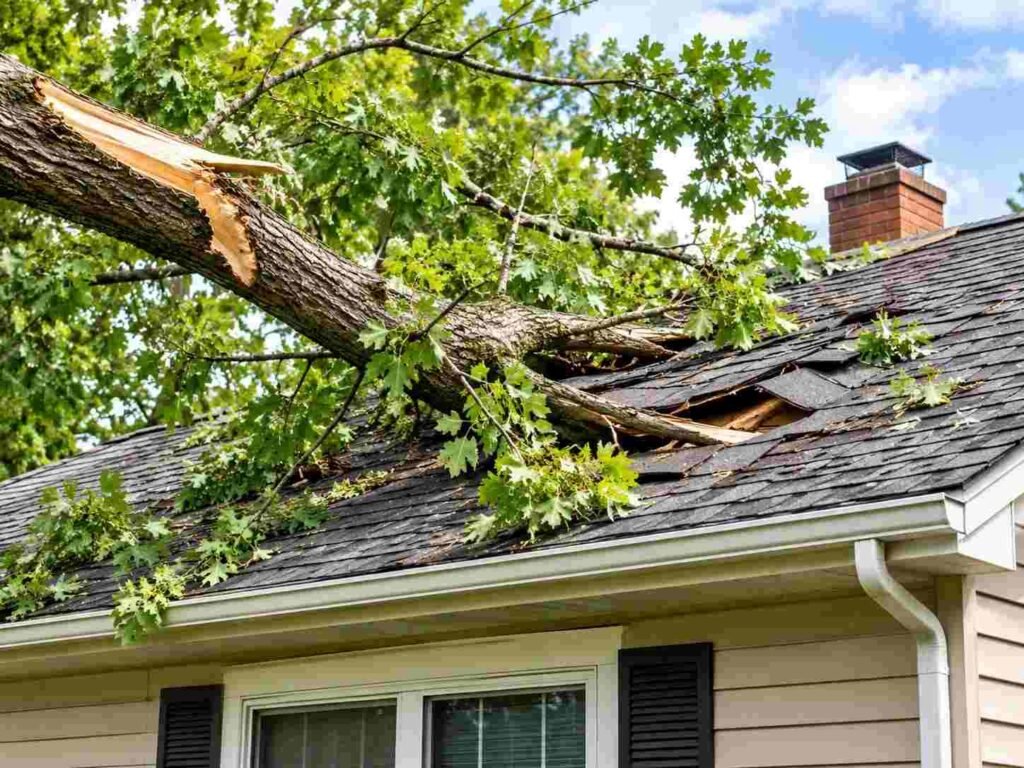
6. How Roof Design Influences Tree-Related Damage
House design can affect the interaction of falling branches with the roofing system.
Roofs vary in shape, pitch, design, and exterior design. These properties can influence the deposit of debris and the parts of the system that are subjected to impact.
For example, a single gable roof might have fewer intersections than a complicated roof with dormers, valleys, skylights, and several slopes.
A branch that falls on an open roof slope area could impact a relatively simple area. But an impact near a dormer or roof intersection could dislodge more flashing and waterproofing connections.
There are a few factors to take into account.
- Roof slope: The slope of the roof may have an effect on whether or not debris stays on the roof or slides across the roof.
- Roof complexity: Roof surfaces with multiple intersections and raised roof elements that overlap.
- Roof age: An older roof may have some deterioration already and be susceptible to further damage.
- Previous repairs: Areas where repair work is already done may require further investigation if further impacts are noted in the same area.
- Structural arrangement: The position and condition of the roof decking, rafters, and trusses can influence how impact forces affect the structure.
Knowing these features will enable both homeowners and roofing contractors to consider the whole roof rather than just the visible point of impact.
7. Signs of Hidden Roof Damage Inside the Home
A difficulty with roof damage from trees is that the damage might not be immediately noticeable from the inside.
Exterior roofing materials can be disturbed by a branch without forming an apparent opening. Rainwater can then infiltrate through later rain and move around on the decking or underneath the structural framing or through cracks or gaps, where it ends up visible inside the house.
This can be confusing, as the area of the interior stain could not necessarily be the same area as the original area hit by the branch.
Homeowners should pay attention to the following warning signs:
- Brown or yellow discoloration on ceilings.
- Damp insulation inside the attic.
- Peeling paint near upper walls.
- Moisture around ceiling fixtures.
- Musty smells in enclosed spaces.
- Water dripping during rainfall.
- Visible changes to ceiling materials.
These symptoms are not all evidence of tree injury. Similar signs can occur from plumbing issues, condensation and other structural issues of the building.
If these changes are observed post-branch falling on the roof, however, the roofing system should be suspected to be a possible source.
Moisture can also cause secondary issues when it stays inside of building materials. Exposure may cause degradation of the effectiveness of wet insulation and may cause damage to wood and interior finishes.
If water comes into contact with electric fixtures or wiring, homeowners should stay out of the area and contact the appropriate professional for help.
8. How Rochester Weather Increases the Risk of Falling Branches
When assessing risks associated with trees as roofing materials, local weather conditions must be taken into account.
Rochester experiences seasonal weather changes that can affect tree stability and the condition of branches near residential buildings.
High wind events and ice storms are noted as factors in the City of Rochester’s Urban Forest Master Plan that could cause harm to trees, break limbs, and lead to tree failure.
These circumstances can lead to various scenarios that can make it more likely there could be storm damage to roofs.
Wind-Related Branch Failure
The pressure of strong wind on tree canopies and weak branches. A broken limb can rip away and drop into a house.
While there is no danger of falling branches, wind roaring can create a risk of branches repeatedly hitting or rubbing the roof.
Ice Accumulation
Ice increases the weight carried by tree branches. If the branch is already weak, the extra weight can make it more likely to break.
Branches that are growing close to residences may pose a problem if they are unable to hold up this extra weight.
Snow-Covered Branches
A large snow load can cause big snags on limbs and shift limb positions. Unstable branches can fall towards a nearby building.
Combined Weather Exposure
If the tree was already damaged in a previous high wind or heavy ice event, it could be more susceptible to damage when it happens again.
The key for homeowners is that risks to roofing can be either sudden, caused by weather conditions, or gradual, caused by changes in vegetation close to the home.
Inspecting trees and removing dead wood and other hazardous branches can help minimise the risk of future occurrences.
9. When Does Tree-Related Roof Damage Require Professional Repair?
After a branch falls onto a roof, homeowners may wonder whether the damage requires a small repair or more extensive work.
This will depend on what components are affected.
These may be minor surface scratches, or may impact shingles, flashing, roof decking or structural framing.
The table below outlines the typical types of damage and actions that can be taken.
| Damage category | Example | Possible response |
| Surface damage | Scratched shingles or damaged granules | Assess the affected roofing materials |
| Localized material damage | Cracked or missing shingles | Replace damaged sections where appropriate |
| Flashing damage | Bent or displaced flashing | Repair or replace affected flashing |
| Decking damage | Cracked or punctured roof sheathing | Inspect and repair damaged decking |
| Structural damage | Damaged rafters or trusses | Obtain an appropriate structural assessment |
| Interior moisture damage | Wet insulation or ceiling materials | Identify the water source and assess affected areas |
The same incident can be in more than one category.
A heavy branch may break a number of shingles, bend a gutter, and in turn impact the roof decking at the same time. When repairs are made to the exterior appearance, they might not solve the whole problem.
This is where Rochester NY roof repair becomes relevant for homeowners dealing with branch-related damage. A qualified roofing professional can assess the affected areas, explain the findings, and identify which components may require repair.
Prior to approving work, homeowners should ask for a detailed explanation of the inspection findings. If the damage is on the surface and not structural, they can make better decisions.
Conclusion
The different roofing issues that can occur on a home roof are caused by falling tree branches and debris, from surface scratches to shingles being blown off, to the decking being damaged to structural problems. The extent of the damage is dependent on the weight of the branches, direction of the fall, landing location and condition of the existing roofing system.
If Rochester residents are worried about home roof damage, it’s important to differentiate between damage caused by direct impact, repeated contact with branches, and concealed moisture issues. Regular property maintenance can be a consideration, as strong winds, ice and heavy snow can cause branches to fall.
If a branch has hit the roof, a professional evaluation may be able to help determine what parts are damaged and if repairs are needed. Homeowners searching for Rochester Local Roofers must remember that a thorough assessment is important and should be based on more than just visual damage. From a minor repair job on your roof to a more significant problem, it is essential to get the advice you need at the right time to avoid additional complications.
If a fallen branch has affected your property or you are unsure whether nearby trees have created a roofing concern, KD Roofers can provide free advice to help you understand your next steps. Contact KD Roofers to discuss your concerns, learn which warning signs may require attention, and determine whether a professional roofing assessment would be appropriate.
Frequently Asked Questions
1. Can a small falling branch cause residential roof damage?
Yes. Even a small branch can scratch shingles, remove protective granules, damage flashing, or affect roofing materials if it strikes a vulnerable area.
2. How can homeowners identify tree-related roof damage?
Look for displaced shingles, damaged gutters, visible punctures, branches resting on the roof, and interior moisture signs after a tree-related incident.
3. Can tree branches damage asphalt shingles without breaking them?
Yes. Repeated rubbing can remove protective granules and wear the shingle surface, even when the material does not appear completely broken.
4. Why can roof leaks appear days after a branch falls?
Water may enter through a damaged roofing layer and travel along underlying components before becoming visible on ceilings or interior walls.
5. Can a fallen branch damage roof decking?
Yes. A sufficiently heavy or concentrated impact can crack or puncture the roof decking beneath the exterior roofing materials.
6. Should homeowners remove branches resting on their roofs?
Large or unstable branches should be handled by qualified professionals. Attempting removal without suitable equipment can create additional damage and safety hazards.
7. Does roof design influence the extent of tree damage?
Yes. Roof slopes, valleys, ridges, skylights, and flashing connections can influence how an impact affects different roofing components.
8. When should homeowners arrange Rochester NY roof repair?
Homeowners should contact a qualified roofing professional when branches have struck the roof, roofing materials appear displaced, flashing is damaged, or water stains develop after an incident.
9. Can severe weather increase the risk of tree-related roof damage?
Yes. Strong winds, ice accumulation, and heavy snow can weaken or break tree branches, increasing the possibility of debris falling onto residential roofs.
10. Can Rochester Local Roofers provide advice about tree-related roofing concerns?
Yes. Homeowners can contact KD Roofers for free advice about roofing concerns and guidance on whether a professional assessment or repair may be appropriate.