

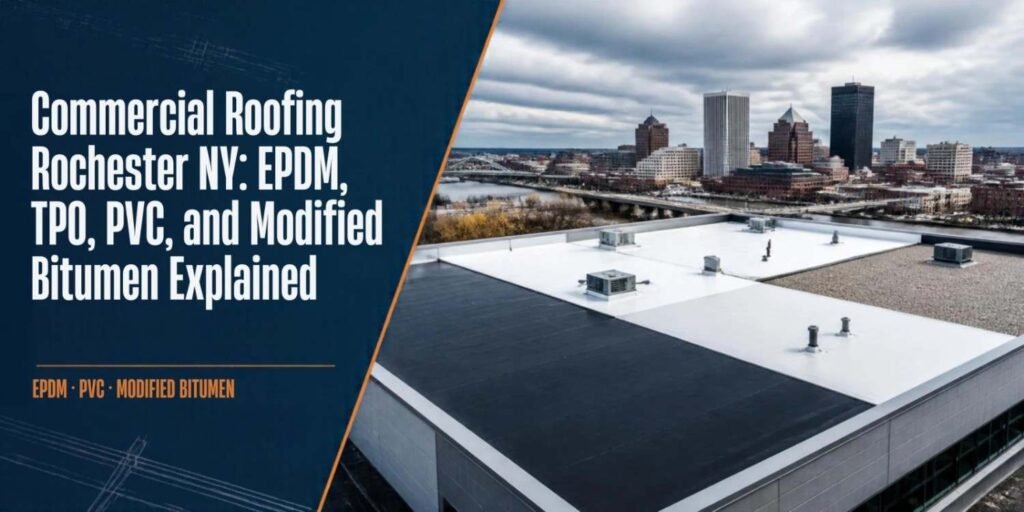
Commercial Roofing Rochester NY: EPDM, TPO, PVC, and Modified Bitumen Explained is an important topic for commercial property owners who need to choose a roofing system that can handle Rochester’s weather, building use, maintenance requirements, and long-term operating costs. Commercial buildings often have large, low-slope or flat roofs, which require different materials and installation methods than many residential roofs. EPDM, TPO, PVC, and modified bitumen are four common options for commercial properties, but each one has different characteristics. Understanding how these roofing systems compare can help property owners make a more informed decision when planning a new roof, replacement, or major repair.
The type of roofing material should also be taken into account based on the weather conditions in Rochester. A commercial roof can be stressed by heavy snowfall, freezing temperatures, ice, rain, wind, and repeated freeze-thaw cycles. Roofs require adequate waterproofing performance, in addition to ease of maintenance and repair.
When speaking with commercial roofers Rochester trusts for installation, replacement, repairs, and inspections, it is important to understand the difference between these materials.
What Is Commercial Roofing?
Commercial Roofing is the roofing system that is used in commercial or industrial buildings like:
- Office buildings
- Retail stores
- Warehouses
- Restaurants
- Apartment buildings
- Medical facilities
- Schools
- Manufacturing facilities
- Shopping centers
- Storage buildings
Commercial roofs are frequently slanted very low, and they are quite large. Waterproofing and drainage will be particularly important on a low-slope roof because water will not run off as quickly.
A commercial roof must also play harmoniously with other building systems like HVAC equipment, vents, drains, skylights, and rooftop access points.
Why Roofing Material Matters in Rochester
Rochester has a variety of weather conditions all year round. Commercial roofs can be subject to high temperatures, heavy rain, high winds, snow, ice and alternating temperatures.
The roof materials may be influenced in various ways by these conditions.
For example, snow on a roof can cause a load on the roof; freeze-thaw cycles can cause migration within roofing materials and other parts. If drainage doesn’t work, water may be a problem on a low-slope roof, too.
That’s why choosing a roofing system should be more than just a comparison of the initial installation cost.
Some points to keep in mind for the owner of the property:
- Expected service life
- Weather resistance
- Waterproofing
- Installation requirements
- Maintenance needs
- Repairability
- Energy performance
- Roof drainage
- Building use
- Total long-term cost
EPDM Roofing Rochester
Ethylene propylene diene monomer is the official name of EPDM. Synthetic rubber roofing membrane used in the low-slope commercial roof market.
EPDM is usually supplied in large sheets, which can be used to cover a large area for roofs. Seams are connected with the appropriate adhesive, tape or other suitable system as per the installation method.
Advantages of EPDM
EPDM is a popular material due to a number of useful properties.
Benefits can include:
- Flexible membrane material
- Useful weather exposure resistance properties
- Relatively simple maintenance
- Can be available in large sheets of membranes
- Works well on numerous low-slope roofs
- Repairable when localized damage occurs
- Long history of commercial use
For building owners seeking a system that has proven to be reliable, EPDM may be a viable building material.
Considerations With EPDM
EPDM is by no means the correct choice for every commercial property.
The owner of the building should think about:
- Roof size
- Drainage conditions
- Rooftop equipment
- Existing roof condition
- Installation method
- Insulation requirements
- Expected maintenance
An expert roof inspection can assist you in identifying if EPDM is suited for your building.
TPO Roofing Rochester NY
TPO stands for thermoplastic polyolefin. TPO roofing is another single-ply membrane system commonly used on commercial buildings. The TPO membranes are usually laid in large sheets, and the seams are often heat-welded to form a continuous waterproofing surface.
Benefits of TPO Roofing
There are a number of benefits that TPO can offer for commercial properties.
These may include:
- Reflective surface options
- Heat-welded seams
- Resistance to weather exposure
- Lightweight membrane construction
- Compatibility with many low-slope roofs
- Relatively straightforward maintenance
When a building owner wants a single-ply roof membrane that is reflective, TPO is often a consideration.
What to Consider Before Choosing TPO
The membrane is only part of the TPO roof. Installation, seam welding, flashing, drainage, insulation, and detailing are important factors.
The property owner should inquire of the contractor:
- What thickness is recommended for the membranes?
- Welding technique: How are seams to be welded?
- What will be done to seal roof penetrations?
- What is the type of insulation used?
- What will be done with drainage?
- What warranty options are available?
PVC Roofing
Another thermoplastic membrane for commercial low-slope roofs is PVC.
PVC membranes can also be seamed, like TPO. PVC is very resistant to moisture and can be beneficial in some commercial environments; however, PVC should also be avoided.
PVC roofing may be used in the following types of buildings:
- Restaurants
- Manufacturing facilities
- Retail buildings
- Warehouses
- Office buildings
The selection of the correct application will rely on the building and conditions surrounding the roof.
Advantages of PVC Roofing
Potential benefits include:
- Heat-welded seams
- Strong waterproofing capability
- Resistance to moisture
- Good durability
- Reflective membrane options
- Suitability for many low-slope commercial roofs
If the building has certain exposure concerns that should be considered, discuss with a commercial roofing professional; PVC might be worth considering.
Modified Bitumen Roofing
A low-slope commercial roofing system that is an asphalt-based roofing system is modified bitumen.
It is a blend of asphalt and polymer modifiers that enhance some properties of asphalt. There are several different methods of installing modified bitumen systems, depending on the product and the building’s requirements.
There are some common ways of installation, such as:
- Self-adhered systems
- Cold-applied systems
- Mechanically attached systems
- Heat-applied systems
The installation method should be determined by the requirements of the manufacturer, conditions of the building, and applicable safety considerations.
Benefits of Modified Bitumen
The modified bitumen can offer:
- Strong waterproofing
- Durable membrane construction
- Multiple installation options
- Repairability
- Good performance on many low-slope roofs
- Longstanding use in commercial roofing
The solution might be a viable choice for property owners who are looking for an asphalt-based commercial roofing solution.
EPDM vs. TPO vs. PVC vs. Modified Bitumen
The four systems have different characteristics.
| Roofing System | Material Type | Common Use | Key Feature |
| EPDM | Synthetic rubber | Low-slope commercial roofs | Flexible membrane |
| TPO | Thermoplastic membrane | Commercial flat/low-slope roofs | Heat-welded seams |
| PVC | Thermoplastic membrane | Commercial buildings | Waterproofing and chemical resistance |
| Modified Bitumen | Asphalt-based | Low-slope commercial roofs | Durable multi-layer options |
No single roofing material is ideal for all Rochester commercial buildings.
Flat Roofing Rochester NY and Drainage
The flat roofing Rochester NY is not a flat roof in its entirety. Most commercial low-slope roofs have a slope of some kind in order to allow water to flow to the drain or other drainage area.
Proper drainage is important; standing water will put extra stress on the roofing system.
A commercial roof can be covered with:
- Internal drains
- Scuppers
- Gutters
- Downspouts
- Tapered insulation
- Roof crickets
- Slope-to-drain designs
Commercial roofers Rochester property owners hire should also inspect the commercial roof to see whether the drains are working properly and whether water is pooling in low spots.
How Snow Affects Commercial Roofs
Snow management is a key aspect of maintenance for commercial roofs in Rochester during the winter.
During prolonged winter storms, snow may pile up on large commercial roofs. Winter management involves the roof structure, drainage system, insulation, membrane and rooftop equipment.
There is no universal standard for the removal of snow from all commercial roofs.
It is important to remove snow carefully so as not to cause damage to:
- Roofing membranes
- Flashing
- Drains
- Rooftop equipment
- Copings
- Seams
If snow cover poses a problem, talk to a roofing professional about a suitable solution.
How Freeze-Thaw Cycles Affect Commercial Roofing
Repeated freeze-thaw conditions can occur due to the changing temperatures in Rochester.
When temperatures fall, water may flow in through cracks or holes and freeze. Water expands when it freezes and can exert pressure on vulnerable areas of the roofing system.
Repeated temperature changes over time can lead to:
- Cracked materials
- Loose flashing
- Damaged seams
- Membrane movement
- Deteriorated sealants
- Drainage problems
Periodic checks may be useful to spot these issues before they become bigger repair tasks.
Roofing Insulation Matters
There is more to a commercial roof than the obvious roof membrane. The roofing assembly can also include such items as insulation, vapor control layers, decking, fasteners, and other elements.
Good insulation can contribute to:
- Better building energy performance
- More consistent indoor temperatures
- Reduced heat transfer
- Protection of the roof assembly
- Better long-term roof performance
Property owners should consider re-using, adding or removing existing insulation when replacing a commercial roof.
Single-Ply vs. Modified Bitumen
The question that will be considered is whether to employ a single-ply system like EPDM, TPO or PVC, or a modified bitumen system.
Single-ply systems are commonly laid down in big single sheets of membrane. Typically, modified bitumen constitutes an asphalt membrane system.
The ideal option is dependent on:
- Building design
- Existing roof
- Budget
- Drainage
- Expected service life
- Maintenance plan
- Rooftop equipment
- Installation requirements
Hiring a professional is more helpful than choosing a material just because of its name or recommended cost.
Roof Repairs vs. Full Replacement
Not all commercial roofs with leaks require a complete replacement.
A professional inspection can help identify if there is a problem or if this is an area of roof failure.
Repairs may be considered when:
- Damage is limited
- The membrane remains in good condition
- Insulation is still performing properly
- Rooftop useful service life remains to be fulfilled
- Leaks can be isolated
When replacement is more feasible, it should be done when:
- Damage is widespread
- The membrane is severely deteriorated
- Insulation is saturated
- Repairs are becoming frequent
- Drainage problems are extensive
- The roof is near the end of its expected service life
Signs Your Commercial Roof May Need Attention
The roof and building changes should be noted by the owner of the property.
These signs might include:
- Water stains on ceilings
- Repeated interior leaks
- Ponding water
- Damaged flashing
- Visible membrane damage
- Open seams
- Cracked sealants
- Damaged roof edges
- Blocked drains
- Wet insulation
- Unusual moisture inside the building
A small problem can be more costly if left unresolved for an extended period.
How to Compare Commercial Roofing Quotes
Do not make a decision on who to hire to complete the job based on price alone when asking for a proposal.
Request each company to detail:
| Quote Detail | Why It Matters |
| Roofing material | Shows exactly what system is proposed |
| Membrane thickness | Helps compare similar systems |
| Insulation | Affects roof performance |
| Tear-off | Shows whether old roofing will be removed |
| Installation | Explains the work included |
| Flashing | Important for waterproofing |
| Drainage work | Helps prevent standing water |
| Warranty | Explains available protection |
| Cleanup | Shows what happens after installation |
| Timeline | Helps plan business operations |
Two quotes may be vastly different in cost because they may be different materials or different scopes of work.
A Simple Commercial Roofing Inspection Checklist
Property owners may have a look at this checklist when they are seeing their roof by a professional:
| Inspection Area | What to Check |
| Membrane | Tears, punctures, cracks |
| Seams | Separation or damage |
| Flashing | Loose or damaged areas |
| Drains | Blockages or standing water |
| Roof edges | Damage or loose components |
| Insulation | Moisture or deterioration |
| Penetrations | Proper sealing |
| Rooftop equipment | Flashing and surrounding areas |
| Interior | Water stains or leaks |
| Previous repairs | Condition of repair areas |
Planning a Commercial Roof Replacement
Here are some things businesses need to think about:
- Customer access
- Employee safety
- Delivery schedules
- Noise
- Equipment placement
- Weather
- Temporary protection
- Waste removal
- Project duration
In a project that will keep an active business running, the contractor should describe how the project will be managed during the building’s operation.
How Rooftop Equipment Can Affect Commercial Roofing
Roofs may also have HVAC systems, vents, exhaust systems, satellite equipment, and other installations on commercial buildings. These systems can create extra spaces that should be thoroughly waterproofed and maintained.
Each roof opening is a potential place where water can enter the roofing system. The seals and flashing around these areas need to be monitored periodically, particularly following severe weather.
Businesses should also take into account the impact of installation or replacement of rooftop equipment on the roofing membrane. Care should be taken by the contractors involved in HVAC installations to avoid any damage to the surface of the roof.
A roofing expert can assess areas around rooftop equipment for:
- Damaged flashing
- Loose seals
- Punctures
- Open seams
- Water stains
- Deteriorated membrane
- Improper equipment supports
There can be less roof damage caused accidentally if there is coordination among roofing and mechanical contractors.
Roof Edge Protection and Commercial Buildings
Wind, rain, snow and temperature fluctuations are factors at the edges of the commercial roof. Roof edge components contribute to the protection of the roofing system and building structure.
Roof edges can feature metal coping, edge flashing, gutters, or other protective parts, depending on the building design.
Any damage around the edge of the roof should not be overlooked. The breakdown or loosening of edge materials can permit water to penetrate to regions under the roofing system.
When the commercial roofing company conducts the roof inspection, it is important for the owner of the building to request a look at the perimeter area of the roof as well as the main roof membrane.
This is especially vital for big buildings in which the roof edges span a considerable surface area.
How Business Operations Can Affect Roof Maintenance
Roofs are utilized in different ways by various businesses. You can find rooftop HVAC systems in a warehouse, or exhaust systems and grease-related equipment in a restaurant. Mechanical units and regular service access for an office building.
Maintenance requirements of the roofing system may be altered due to these activities.
For example, a high volume of pedestrian foot traffic can raise the risk of accidental damage to the roof’s membrane. Providing walkways can assist maintenance personnel and service technicians in moving throughout areas where access is required.
It’s also important for businesses to let contractors know what access they need for the roof before installing new roofing systems. This can be useful for the roofing crew to determine the correct roofing protection for the high-traffic areas.
Protecting a Commercial Roof During Other Building Work
Sometimes damage to the roofing occurs as part of a project unrelated to roofing that is being constructed or maintained.
Workers might need to get on the roof for electrical jobs, replacing the HVAC system, installing solar panels, signage projects, and more.
The building owner should verify the ways in which the building’s existing roof will be protected before the start of work by another contractor.
Helpful tips can be:
| Project Activity | Roofing Consideration |
| HVAC replacement | Protect membrane around equipment |
| Electrical work | Prevent tools and materials from puncturing roof |
| Solar installation | Plan mounting and waterproofing carefully |
| Sign installation | Protect penetrations and flashing |
| Building maintenance | Use designated roof access paths |
| Construction work | Keep debris away from drains |
Taking the time to plan can save avoidable roof repairs.
When to Schedule a Commercial Roof Inspection
When it comes to commercial roof maintenance, time can be a factor! Property owners should arrange for inspections after any major weather events and before times of extreme seasonal weather.
Inspections can be especially helpful following winter or heavy storm seasons for Rochester businesses.
It is possible to find issues that may not be detected from within the building structure through a professional inspection. Minor damage can be easier to take care of if it is detected early, before it becomes a big problem.
An inspection should also be scheduled when:
- A roof begins leaking repeatedly
- New rooftop equipment is installed
- The building changes ownership
- A major storm affects the property
- The roof becomes older
- Repairs become more frequent
- Water begins collecting in new areas
Keeping Commercial Roofing Records
Keeping straightforward bookkeeping of the roofing exercise can assist the property owner to deal with the roof throughout its service life.
Records can include:
- Installation date
- Roofing material
- Contractor information
- Warranty documents
- Inspection reports
- Repair dates
- Repair descriptions
- Photographs
- Maintenance records
- Drainage improvements
These records can be helpful in planning for future repairs and replacement. They can additionally assist a new building owner in learning about the background of the roof system.
With large commercial properties, the maintenance process can be a lot easier if there’s some organization to the roofing information.
Final Thoughts
Commercial roofing Rochester NY requires careful consideration of the roofing material, building design, drainage, insulation, installation quality, and long-term maintenance. EPDM, TPO, PVC, and modified bitumen can all be useful commercial roofing systems, but each has different characteristics.
EPDM may be a practical choice for businesses looking for a flexible rubber membrane. TPO and PVC provide thermoplastic membrane options with heat-welded seams, while modified bitumen offers an asphalt-based solution for many low-slope commercial applications.
For Rochester properties, weather and drainage should be part of the decision. A commercial roof must be prepared to handle rain, snow, ice, wind, and changing temperatures throughout the year.
Rather than choosing a roofing material based only on the initial price, property owners should compare the complete roofing system, installation requirements, maintenance needs, expected performance, and long-term value. Working with experienced commercial roofers Rochester businesses trust can help property owners choose a system that fits the building and its specific needs.
Frequently Asked Questions
1. What is the best commercial roofing material for Rochester NY?
There is no single best option for every building. EPDM, TPO, PVC, and modified bitumen can all be suitable depending on the roof design, drainage, budget, building use, and maintenance requirements.
2. Is EPDM good for commercial roofs in Rochester?
EPDM can be suitable for many low-slope commercial roofs. Its flexible membrane construction and long history of commercial use make it an option worth considering.
3. What is TPO roofing?
TPO is a thermoplastic single-ply roofing membrane commonly used on commercial low-slope roofs. Its seams are typically heat-welded during installation.
4. Is PVC roofing suitable for commercial buildings?
PVC can be suitable for many commercial buildings and provides a waterproof membrane system with heat-welded seams.
5. What is modified bitumen roofing?
Modified bitumen is an asphalt-based roofing system designed for low-slope applications. It can be installed using several different methods depending on the product and project.
6. Are commercial roofs completely flat?
Most commercial roofs described as flat roofs have a slight slope. This slope helps direct rainwater and melting snow toward drains or other drainage systems.
7. How often should a commercial roof be inspected?
The appropriate inspection schedule depends on the roof’s age, material, condition, building use, and local weather exposure. Regular professional inspections can help identify problems early.
8. Can a commercial roof be repaired instead of replaced?
Yes. If damage is limited and the existing roofing system remains in reasonable condition, repairs may be possible. A professional inspection can determine the appropriate approach.
9. Why is drainage important for commercial roofing?
Proper drainage helps prevent water from remaining on the roof for extended periods. Blocked or poorly designed drainage can contribute to roofing problems.
10. What should I compare when getting commercial roofing estimates?
Compare the roofing material, membrane specifications, insulation, tear-off work, flashing, drainage, installation, warranties, cleanup, and project timeline rather than looking only at the total price.