

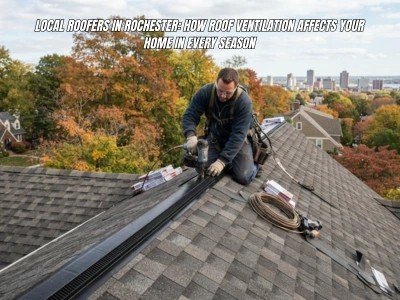
Local Roofers in Rochester: How Roof Ventilation Affects Your Home in Every Season is an important topic for homeowners because proper roof ventilation Rochester can affect both the condition of the roof and the comfort of the home. A roof does more than protect a property from rain, snow, and sunlight. Proper airflow through the attic helps manage heat and moisture, which can otherwise become trapped and lead to roofing and attic problems over time.
Changes in climate happen year-round in Rochester homes. Summer heat and humidity, winter cold, snow, ice and seasonal temperature fluctuations can impact the performance of a roof and attic. These conditions can be controlled by providing adequate ventilation to the roof fresh air in and warm/moist air out.
Knowing how ventilation works in all seasons of the year can help homeowners determine any issues with their roofing system and make the conversation with a professional a bit easier.
What Is Roof Ventilation?
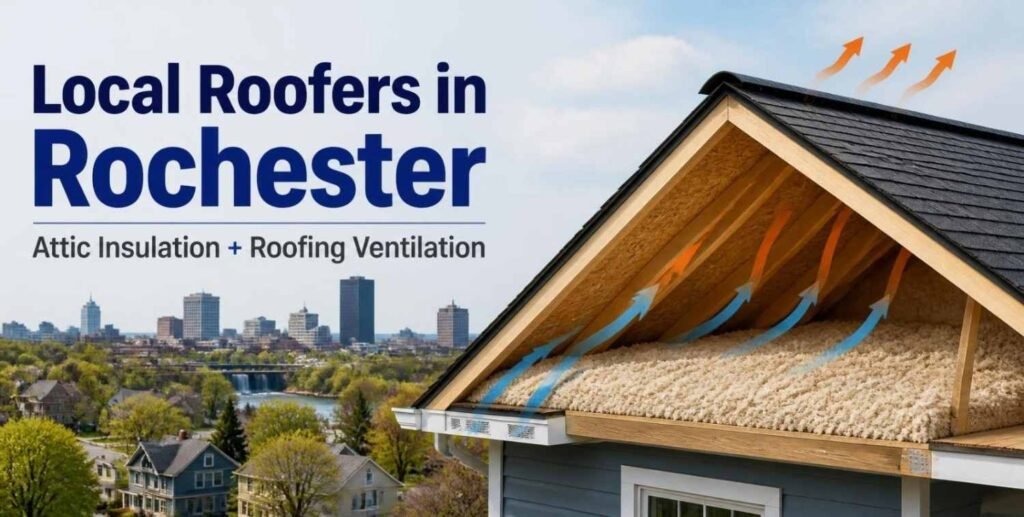
Roof ventilation is a system that is used to let air flow through the attic. It typically operates by moving cooler outdoor air in the lower part of the attic and warm, moist air out through the upper ventilation openings.
Usually, a mixture of intake and exhaust vents is used in a properly designed system.
Intake vents may be installed near the roof’s lower edges, while exhaust vents are typically positioned closer to the roof peak.
The idea is not to simply throw in a few vents without understanding how they will function together to provide continuous airflow.
There are several popular methods of roof ventilation:
- Soffit vents
- Ridge vents
- Gable vents
- Box vents
- Turbine vents
- Powered attic fans
The type of setup depends on the roof design and the attic configuration, insulation, and before ventilation.
Why Roof Ventilation Matters in Rochester
The airflow in the attic is especially significant in Rochester due to the fluctuation in weather.
In summer, the attic can be extremely hot, especially in comparison to outside temperatures. If the attic is not insulated and ventilated well, warm air from the living area may cause moisture problems during the winter months.
This does not mean that ventilation is only important during hot weather, but all year round.
A good ventilation system can aid:
- Reduce excessive attic heat
- Control moisture buildup
- Support the condition of roofing materials
- Reduce the risk of condensation
- Improve attic air movement
- Support the performance of insulation
- Reduce some seasonal stress on roofing components
However, ventilation is just one component of a roofing system. Other factors that also play a significant role include proper insulation, air sealing, flashing, drainage, and roof maintenance.
Roof Ventilation During Rochester Winters
Winter can be one of the most crucial seasons for focusing on attic ventilation.
Moisture may condense on cooler areas if warm air in the living areas flows to a cool attic area. This can happen time and time again, and it can cause moisture problems for insulation, wood elements, and more.
A poorly vented attic may also lead to uneven roof temperatures.
Preventing Excess Moisture
One of the main problems in the winter months is moisture.
Cooking, indoor showering, washing clothes, and drying them indoors can introduce moisture into the home. When warm, moist air infiltrates into the attic, it may condense on cold surfaces.
Ventilation moves air through the attic, and proper air sealing and insulation stop warm indoor air from entering the attic.
Reducing Ice Dam Conditions
Ice dams can occur when snow on warmer areas of a roof surface melts, and then refreezes along cooler roof edges.
Along with insulation and air sealing, roof ventilation Rochester can be used to help keep attic and roof temperatures more consistent.
But ventilation can’t prevent ice dams from forming.
Ice damming can happen due to snow conditions, roof design, insulation, air leakage, outside temperatures, and more.
If ice dams occur time and again, it’s best to have the whole roofing system and the attic inspected instead of expecting a single vent to cure the issue.
Spring and Roof Ventilation
Spring is a time of transition, with warmer temperatures, melting snow, rain, and moisture levels.
A few things may now be noticed in the home by homeowners after winter that were not noticed during the winter months.
These can include:
- Damp attic insulation
- Water stains
- Musty odors
- Mold-like growth
- Damaged roof sheathing
- Peeling paint near attic areas
- Excess moisture around roof penetrations
A good time for homeowners to check the attic and roofing system is spring.
Once ventilation issues are identified, a professional will be able to determine if it is a problem with inadequate vents, blocked intake openings, insulation placement, or another roof condition that is causing the ventilation problems.
Summer Heat and Your Attic
In summer, the sun and the attic under the roofing materials can get hot. If not properly ventilated, hot air can be trapped in the attic for extended periods. This can cause the attic to be very hot and can lead to the transfer of heat to the living space.
Managing Attic Heat
Ventilation in the roof enables heated air to escape the attic space and outdoor air to enter the attic through vents.
This constant motion can assist in minimizing the accumulation of too much heat.
But don’t consider ventilation as an alternative to insulation.
Ventilation moves air through the attic and insulation slows the flow of heat between the attic and the living areas.
They both serve distinct functions.
Summer Humidity
Rochester summers can also bring humid conditions.
Warm, humid air can be a problem in attics when there is inadequate ventilation.
Properly designed ventilation can also help to move moist air through the attic space, but homeowners should also inspect their homes for sources of indoor humidity and air leakage.
Fall Preparation for the Roof
It is good to make preparations ahead of winter for a roofing system in the fall.
Roof areas can collect leaves, other debris, and may clog ventilation openings.
To determine if:
- Soffit vents are clear
- Attic vents are unobstructed
- Exhaust vents are functioning
- Insulation is not blocking intake vents
- Roof penetrations are properly sealed
- The attic shows signs of moisture
An inspection of the roof prior to winter can prevent minor issues from becoming more serious due to snow and ice.
The Connection Between Insulation and Ventilation
Ventilation and insulation are not synonymous.
Insulation helps to regulate heat flow between the interior of the home and the attic.
Ventilation enables air to flow in the attic.
Installing insulation improperly and covering soffit vents may cause the ventilation system to operate incorrectly.
Likewise, poor ventilation will not fix significant air leakage or areas of poor insulation.
That is why, more often than not, residential roofers must consider the entire roof system and not just the roof’s ventilation.
Signs Your Roof Ventilation May Need Attention
The problem with ventilation may not be noticed by homeowners right away.
Symptoms may be seen within the attic area or elsewhere in the home.
Look for:
Excessive Attic Heat
If the attic is unusually hot in the summer, this may be a sign of inadequate airflow, but it could also simply be a high attic temperature compared to the outside temperature during the summer.
Condensation
If moisture droplets are visible on roof surfaces, such as roof decking, nails, or other surfaces, there may be a moisture issue.
Damp Insulation
It can also be ineffective if it is wet or compressed, and could indicate the presence of moisture.
Musty Odors
If the attic is constantly smelling musty, it may mean that there is too much moisture there or other issues.
Mold-Like Growth
Any areas that are dark or discolored on wood surfaces should be evaluated and not ignored.
Damaged Roof Materials
Moisture and bad attic conditions are only two possible causes of premature deterioration of roofing components.
How Local Roofing Companies Rochester Homeowners Work With Can Check Ventilation
More than just counting the roof vents is a roof ventilation inspection.
The whole path of the airflow should be taken into account by professionals.
Some of the Rochester homeowners’ local roofing companies they call will check for:
- Soffit vents
- Ridge vents
- Gable vents
- Roof vents
- Attic insulation
- Roof decking
- Signs of condensation
- Air leaks
- Roof penetrations
- Existing moisture damage
This is to determine if air is moving into and out of the attic as designed.
How Roofers Rochester NY Can Identify Ventilation Problems
Roofers Rochester NY can spot ventilation problems during a standard roof inspection, particularly when homeowners report moisture, heat, or problems related to the winter season.
A professional assessment may be helpful to ascertain if the current system is:
- Properly balanced
- Partially blocked
- Undersized for the roof
- Installed incorrectly
- Affected by insulation
- Missing appropriate intake ventilation
- Missing sufficient exhaust ventilation
This assessment is significant because increasing the number of exhaust vents does not necessarily mean better ventilation if not accompanied by an increase in intake airflow.
Intake and Exhaust Ventilation Must Work Together
Balance is one of the most crucial ideas for attic ventilation. Intake and exhaust airflow are required in an attic.
A ridge vent might, for instance, be a place where warm air can escape from the attic. However, if there are not enough fresh air vents in the soffit or the soffit vents are blocked, there may be insufficient fresh air movement to support the intended fresh air flow pattern.
Likewise, an intake vent without an adequate exhaust can not yield results. The ventilation system should then be considered as a system.
| Season | Common Roof Ventilation Concern | How Proper Ventilation Helps |
| Winter | Condensation, cold attic surfaces, and ice dam conditions | Helps maintain more consistent attic temperatures and move moist air |
| Spring | Melting snow, rain, damp insulation, and moisture buildup | Helps identify and manage moisture and airflow problems after winter |
| Summer | Excessive attic heat and humidity | Allows hot air to escape and supports better attic airflow |
| Fall | Leaves, debris, and blocked ventilation openings | Helps prepare intake and exhaust vents for winter |
| Year-Round | Poor airflow, blocked vents, moisture, and insulation problems | Supports balanced airflow and helps protect the overall attic and roofing system |
Does Every Roof Need the Same Ventilation System?
No. Each home comes in a variety of shapes, attics, insulation, and ventilation needs. The soffit and ridge roof ventilation on a simple roof may be very simple.
If the house has several roof surfaces, dormers, gables, or complex attic areas, another solution might be necessary. Roof design is also important, as some ventilation products are not appropriate for all roof designs. This is just one of the reasons homeowners do not want to buy products for the house for ventilation only based on their looks or price.
Roof Ventilation and Older Rochester Homes
Some older homes may be constructed with roofing and attic systems that were built in an older manner.
Some may lack adequate ventilation or insulation, as it is no longer what is expected today.
The opportunity is there, when replacing the roof, to examine the attic ventilation system.
But replacing the roof doesn’t necessarily require the entire ventilation system to be replaced.
A professional will be able to decide if there are existing components that can be kept and what changes might be necessary.
Can Poor Ventilation Damage a Roof?
Excess heat or moisture buildup for long periods of time can be caused by poor ventilation, which can impact roofing materials.
This moisture can impact wood elements and insulation, and some roofing materials may be stressed by excessive heat.
Roof deterioration may be caused by a leak, installation issues, aging materials, or other causes, and a thorough inspection must be performed to identify the cause of the deterioration.
Roof Ventilation and Energy Efficiency
Sometimes homeowners have unrealistic expectations regarding roof ventilation, thinking it will have a significant impact on their energy costs. Such expectations should be realistic.
The primary purpose of ventilation is to control air movement, heat, and moisture in the attic. Insulation and air sealing are important factors in regulating movement of conditioned air into and out of the house and attic.
The ventilation system can be a part of the whole building envelope and contribute to the overall home performance.
When Should You Contact a Roofing Professional?
If homeowners notice any of the following, they should consider having it inspected by a professional:
- Repeated condensation in the attic
- Wet insulation
- Mold-like growth
- Roof decking discoloration
- Persistent attic odors
- Recurring ice dams
- Unusual roof deterioration
- Blocked or damaged vents
- Significant attic heat
- Unexplained moisture problems
A professional inspection can help determine if there is a problem with the ventilation or a leak in the roof, insulation, plumbing, or elsewhere.
Questions to Ask About Roof Ventilation
Before making changes to a ventilation system, homeowners can ask:
- Does my attic have enough intake ventilation?
- Is the exhaust ventilation properly positioned?
- Are my soffit vents blocked?
- Is insulation covering any ventilation openings?
- Is there evidence of condensation?
- Could air leakage be contributing to moisture?
- Is the current system suitable for my roof design?
- Do I need additional ventilation or a different configuration?
- Could existing vents be repaired instead of replaced?
- Should the attic be inspected before winter?
Homeowners can find out about their current system with these questions.
Common Roof Ventilation Mistakes
There are a few errors that can diminish the efficiency of an attic ventilation system.
Blocking Soffit Vents
Sometimes a cover of insulation will cover intake openings. Ventilation channels should be kept open as necessary.
Adding Exhaust Vents Without Considering Intake
Too many exhaust vents are not necessarily a good thing. All the air flow system should be balanced.
Ignoring Moisture Sources
Bathroom exhaust fans, plumbing leaks, or air leakage are not causes for ventilation to mask the problem.
Installing the Wrong Vent Type
Not all ventilation products will fit all roofs.
Waiting Until Damage Appears
There could be a smaller ventilation problem that can be solved before it becomes a larger ventilation/moisture/roofing problem.
What to Expect During a Ventilation Inspection
An outside examination of the roof may be the first step during an inspection by a professional.
The roofer may then examine the attic to evaluate airflow, insulation, moisture signs, and the condition of roof decking.
Depending on the situation, they may recommend:
- Clearing blocked vents
- Improving intake airflow
- Adjusting insulation
- Repairing damaged vents
- Improving air sealing
- Installing additional ventilation
- Replacing unsuitable components
The solution recommended should be specific to the home and not just increase the number of vents.
Planning Roof Ventilation During a Roof Replacement
Replacing a roof may be a good time to take a look at ventilation.
After the old roofing material is stripped off, some sections of the roof system might be more easily inspected.
The roofing contractor can take the homeowner’s request to assess:
- Existing intake vents
- Exhaust vents
- Roof decking
- Attic airflow
- Insulation placement
- Signs of moisture
- Areas around roof penetrations
This can help to ensure that the new roof has an appropriate attic ventilation system.
Why Year-Round Roof Maintenance Matters
Roof ventilation is not something that only comes into the picture in the summer or winter.
It can have residual impacts all year.
It’s cold in the winter, and condensation is an issue. Spring is the time when snow melts and it rains. It’s a hot and humid summer. Fall is the time to get the roof and attic ready for the next winter.
House owners can be alert for ventilation and roofing problems by conducting regular inspections and taking action before the problems become more troublesome.
Final Thoughts
Local Roofers in Rochester can help homeowners understand how roof ventilation affects the roof and attic throughout the year. Proper airflow can help manage heat and moisture, while good insulation and air sealing support the overall performance of the home.
Rochester’s climate means that homeowners shouldn’t just consider ventilation in the hottest or coldest seasons. In all seasons, a ventilation system should function as a part of the entire roofing and attic system.
A professional inspection can be used if there is condensation, excessive heat in the attic, frequent ice dams, wet insulation, or other indications present, to identify the cause and, if necessary, whether ventilation is appropriate.
FAQs
1. How often should attic ventilation be inspected?
Homeowners can have ventilation checked during regular roof inspections, especially when preparing for major seasonal weather or noticing changes in attic conditions.
2. Can attic ventilation affect the lifespan of roofing materials?
Proper ventilation can help manage heat and moisture conditions that may contribute to premature deterioration, although roof lifespan also depends on materials, installation, weather, and maintenance.
3. Can bathroom fans cause attic moisture problems?
Yes. If a bathroom exhaust fan vents into the attic instead of outdoors, warm and humid air can enter the attic and contribute to condensation and moisture problems.
4. Should attic vents be covered during winter?
Generally, attic ventilation should continue during winter. Blocking vents can interfere with airflow and may contribute to moisture problems.
5. Can snow block roof ventilation?
Heavy snow can cover certain exterior ventilation openings depending on their design and location. A roofing professional can check whether the ventilation system remains functional.
6. Does a ridge vent work without soffit vents?
A ridge vent is designed to work as part of an overall ventilation system. Without adequate intake airflow, its effectiveness may be limited.
7. Can roof ventilation remove attic moisture completely?
Ventilation can help move moist air, but it cannot eliminate moisture caused by leaks, excessive indoor humidity, or uncontrolled air leakage.
8. Are powered attic fans necessary for every Rochester home?
No. Whether a powered fan is appropriate depends on the existing ventilation design, attic conditions, and the home’s specific requirements.
9. Can insulation block roof vents?
Yes. Insulation can obstruct soffit or intake ventilation if it is installed incorrectly. Proper airflow channels should be maintained where needed.
10. Is roof ventilation checked during a roof replacement?
It can be. Roof replacement provides an opportunity to inspect existing ventilation, roof decking, and other components, although the exact inspection scope depends on the contractor and project.